Singapore to South Korea Shipping Costs 2026: Sea, Air, Duty
Updated: 2026-09-29
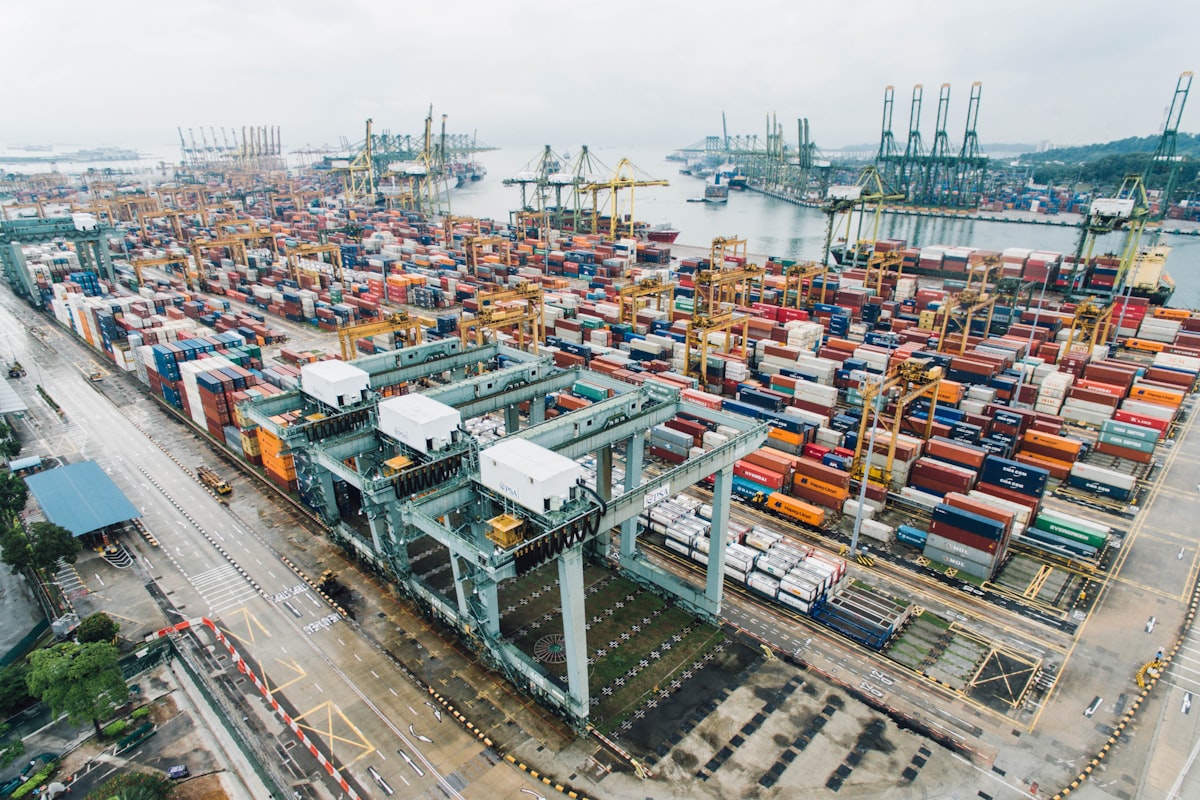
This Lane Starts at USD 534, and One Document Decides the Rest
A 20ft container from Singapore to South Korea is quoted at USD 534 this month. A 40ft is USD 811 and a 40HC is USD 853. Those are port-to-port numbers off a forwarder's own published rate card, and they are the only part of this lane that behaves like a market. Send the same box back the other way, Busan to Singapore, and the same card wants USD 738, USD 990 and USD 1,052. Singapore to Busan is the cheaper direction, by 22% to 38%, because that is where the loaded volume moves. What actually moves on this lane is heavy: machinery, electronics, chemicals and pharmaceuticals make up most of Singapore's export mix to Korea, and very little of it is consumer parcels. So the freight quote is the wrong thing to negotiate first, because two identical 40HCs leaving Keppel at the same hour can walk into Busan with duty bills that differ by the entire duty line, and the difference is one sheet of paper that has nothing to do with the ocean rate.
I price this lane about twice a month for Singapore-based suppliers, and the pattern never changes. The buyer spends three emails arguing about USD 40 of ocean freight, then discovers the duty question in the last week before the vessel sails. The box costs USD 853. That is roughly 2% of a typical 40HC cargo of machinery. The duty decision I make with them is worth somewhere between 0% and 13% of the same cargo. Put those two numbers side by side and the priority order argues itself. I have never once seen a consignment saved by winning the freight argument, and I have seen plenty damaged by losing the origin one.
| Lane and box | Rate this month | What the number includes | What it leaves out |
|---|---|---|---|
| Singapore to Busan, 20ft | USD 534 | Base ocean freight, port to port | Origin handling, terminal charges, clearance, delivery |
| Singapore to Busan, 40ft | USD 811 | Base ocean freight, port to port | The same list, plus any peak season surcharge |
| Singapore to Busan, 40HC | USD 853 | Base ocean freight, port to port | The same list, and the extra cube costs USD 42 more |
| Busan to Singapore, 20ft | USD 738 | Base ocean freight, port to port | The 38% premium is structural, not a negotiation failure |
| Busan to Singapore, 40HC | USD 1,052 | Base ocean freight, port to port | Backhaul economics decide this one, not your broker |
Quote Screen One: Choose the Mode Before You Argue About the Rate
There are four ways to move freight on this lane and they are not variations of each other. LCL on an intra-Asia route is priced per cubic metre, and the band I see runs from USD 50 to USD 150 per CBM depending on the consolidator and how flexible you are on sailing dates. FCL is priced per box, and the box does not care what is inside it. Air is priced per chargeable kilogram and it takes days off the transit. The mistake is choosing the mode by headline rate instead of by volume, because the crossover point is not where most buyers assume it is.
The LCL to 20ft break-even on this lane sits around 12 to 15 CBM. Below it LCL is cheaper and nobody should talk you into a box. Above it a 20ft is cheaper and nobody should talk you into LCL, because the origin and destination fixed charges are paid again on every booking. On one shipment those charges look small. On a monthly replenishment cycle they become the second biggest line after the goods themselves. If you sit in the awkward middle, at 18 CBM, the tie-breaker is not price. It is whether you can carry one more month of stock, because a 20ft that sails half full on your schedule beats a perfectly optimised LCL consolidation that misses your delivery window.
| Mode | Rate | Transit | Where it wins | Where it hurts |
|---|---|---|---|---|
| LCL sea | USD 50 to 150 per CBM, plus fixed origin and destination charges | 3 to 8 days port to port | Under about 12 CBM, and any shipment you cannot fill | The fixed charges repeat on every single booking |
| 20ft FCL | USD 534 | 3 to 8 days | From roughly 12 to 15 CBM upward | You pay for the box even when it sails half empty |
| 40ft or 40HC FCL | USD 811 to 853 | 3 to 8 days | From about 25 CBM or 12 pallets | The 40HC is USD 42 more, so take the height |
| Air freight | Priced per chargeable kilo | 1 to 3 days | Goods worth more than about USD 15 a kilo, or a hard deadline | Cost per kilo climbs with density, not with value |
Quote Screen Two: Does Your Cargo Actually Originate in Singapore?
This is where most of the money is lost on this lane, and it is a Singapore-specific problem. Singapore is a transshipment and consolidation hub, so a large share of what leaves it was made somewhere else. The Korea-Singapore Free Trade Agreement removes 91.6% of Korea's tariffs on Singapore exports, which sounds like a blanket answer to the duty question. It is not. The concession attaches to goods that originate in Singapore under the agreement's product-specific rules, and it is claimed with a Preferential Certificate of Origin filed together with the export permit through TradeNet, with Singapore Customs as the authorised issuing body. Goods that are merely warehoused, relabelled or re-consolidated in Singapore do not become Singapore goods. They walk into Busan at Korea's ordinary rate.
I will be blunt about this one, because I watched an importer lose a quarter's margin to it. He bought from a Singapore trading company, saw Singapore on the invoice, and priced the deal at zero duty. The goods were made in China, the value added in Singapore was a label and a warehouse, and Korea's customs service asked for the origin documentation that decides the preference. He paid the ordinary rate on the whole consignment, plus the VAT on top, and no certificate that could be produced afterwards would have fixed it. The question to ask before booking is not who you are buying from. It is where the goods were produced, and the answer has to sit on a document your broker can file with the declaration.
| What your goods are | KSFTA preference available? | What Korea charges | What I do |
|---|---|---|---|
| Made in Singapore from Singapore materials | Yes, subject to the product-specific rule | The preferential rate, which is 0% on most finished lines | File the certificate through TradeNet with the export permit |
| Assembled in Singapore from imported parts | Depends on the rule of origin for that HS line and the assembly test | Either 0% or the ordinary rate, with nothing in between | Read the product-specific rule before quoting, not after |
| Chinese or EU goods consolidated in Singapore | No | Korea's ordinary rate, plus 10% VAT | Ask whether the ASEAN-Korea agreement is a second track that fits |
| Goods originating in another ASEAN country, shipped via Singapore | Possibly, but under a different agreement and its own form | 0% only if that agreement's origin rules are met | Have the broker confirm which agreement is being claimed |
| Nobody knows where it was made | No, and it becomes a customs question | Whatever the broker decides, plus the delay | Get documentary proof of production from the supplier first |
The 91.6% Number, and the Lines It Left Behind
The Korea-Singapore agreement is not new, which is exactly what makes it useful. The tariff schedule has already run its course, so you can read a finished answer instead of a phase-out plan. The published preferential schedule shows the rate Korea applies to Singapore-origin goods by HS line from 2012 onward. On the consumer lines that dominate small importers' shipments the sequence was identical: 4.7% in 2012, 3.5% in 2013, 2.4% in 2014, 1.2% in 2015 and zero from 2016 onward. Several product families started at zero and never had a phase-in at all. That difference matters, because it tells you which lines ever needed a certificate and which never did.
Read that table the way a buyer should. Cosmetics, laptops, leather dress shoes and ceramic tableware never needed a certificate on this lane, because the preferential rate was zero from day one. Garments, wine, perfumes and jewellery did, and anyone importing those lines without filing the certificate has been paying more than the agreement allows, every month, for years. Here is why this is worth checking rather than assuming. Korea's ordinary rate on finished garments sits in the 8% to 13% band. On a garment consignment, the gap between claiming the preference and not claiming it is therefore the entire duty bill, not a rounding difference. Have your broker read the exact line off Korea's own tariff database before you quote anything, and treat the 91.6% headline as a reason to check rather than as an answer.
| Product and HS line | 2012 | 2013 | 2014 | 2015 | 2016 and later |
|---|---|---|---|---|---|
| Cotton T-shirts, 6109.10.1000 | 4.7% | 3.5% | 2.4% | 1.2% | 0% |
| Denim jeans, 6203.42.1000 | 4.7% | 3.5% | 2.4% | 1.2% | 0% |
| Men's cotton shirts, 6105.10.0000 | 4.7% | 3.5% | 2.4% | 1.2% | 0% |
| Wool suits, 6204.11.0000 | 4.7% | 3.5% | 2.4% | 1.2% | 0% |
| Red wine in containers under 2 litres, 2204.21.1000 | 5.5% | 4.1% | 2.7% | 1.4% | 0% |
| Perfumes and toilet waters, 3303.00.1000 | 2.9% | 2.2% | 1.5% | 0.7% | 0% |
| Platinum jewellery, 7113.19.1000 | 2.9% | 2.2% | 1.5% | 0.7% | 0% |
| Portable computers, 8471.30.0000 | 0% | 0% | 0% | 0% | 0% |
| Leather dress shoes, 6403.51.1000 and 6403.99.1000 | 0% | 0% | 0% | 0% | 0% |
| Lipstick, eye shadow and face powder, 3304 | 0% | 0% | 0% | 0% | 0% |
| Ceramic household articles, 6912.00.2000 | 0% | 0% | 0% | 0% | 0% |
The USD 150 Line, and the Two Kinds of Import It Separates
Korea exempts low-value goods from duty and tax: consignments priced at no more than USD 150 pay neither. That line is real, and it is generous by comparison with the European Union, where the equivalent low-value treatment has been dismantled. It is also close to irrelevant to a business shipment, and the reason is the way Korea clears the two halves of its import book. A personal parcel and a commercial consignment do not travel through the same process, and the USD 150 exemption belongs to the first one, for self-use goods. If you are importing stock to sell, the exemption is not a planning tool. It is a category you are not in.
The Personal Customs Clearance Code is the detail almost nobody outside Korea knows until it stops a delivery. Korea's customs service describes it as a unique personal identification number used when going through customs clearance, substituted for the resident registration number in the import declaration of personal items, and its published format is one letter followed by twelve digits. Foreigners who buy goods from overseas and hit clearance need one, and a passport alone is not enough to apply online, so the fallback is a visit to a customs office. If you are sending samples or personal effects into Korea rather than stock, this is the single item most likely to hold your delivery, and it is a ten-minute fix before the parcel lands rather than a three-week problem after it is held.
| Personal parcel | Commercial consignment | |
|---|---|---|
| Value treatment | Up to USD 150, exempt from duty and tax | No exemption: duty plus VAT from the first dollar |
| Clearance route | Simplified clearance for self-use goods | Formal import declaration through UNI-PASS |
| Who declares | The recipient, using a Personal Customs Clearance Code | A licensed customs broker, or your own customs ID |
| Identifier | PCC code: one letter plus twelve digits | Business registration number and customs ID |
| Tax | Nil while the consignment stays under USD 150 | 10% VAT on the value plus duty |
| Crossing the line | Duty and tax apply to the whole consignment | Always payable, at any value |
The 10% That Arrives Even When the Duty Is Zero
Korea charges value added tax on imports at 10%, and the base is the customs value plus duty. That means the tax is charged on the duty as well, so removing the duty removes a slice of the base rather than the tax itself. This is the number to put in your landed cost sheet first, because it applies to every commercial consignment on this lane regardless of origin, agreement or certificate. Take the route's own worked example and run it both ways: goods FOB USD 3,200, LCL of 2 CBM at USD 130 per CBM for USD 260, insurance at 0.5% for USD 16, clearance fees of USD 90 and inland delivery of USD 130. The duty-paid value before duty is USD 3,476.
I put those two versions in front of a client last month and watched him go quiet. He had spent a week negotiating USD 30 off the LCL rate and was about to book without an origin certificate, because his supplier had told him the paperwork was complicated. The certificate was worth USD 497.07 on that consignment. The negotiation was worth USD 30, once. Korea's VAT is not avoidable and should never be treated as a cost you can engineer away on this lane. The duty is avoidable, and the certificate is the only thing that avoids it.
- Duty-paid value after the certificate: USD 3,200 of goods plus USD 260 of freight plus USD 16 of insurance equals USD 3,476
- With a valid Preferential Certificate of Origin: duty USD 0.00, then VAT of 10% on USD 3,476 which is USD 347.60, plus USD 220 of clearance and delivery
- Without the certificate, on a garment line taxed at 13%: duty USD 451.88, then VAT of 10% on USD 3,927.88 which is USD 392.79, plus the same USD 220
- The certificate is worth USD 497.07 on this consignment, which is 14.3% of the cargo value
- The freight line people argue about is USD 260, so the document is worth nearly twice what the negotiation was about
What the Korean Border Adds in Days, Not Dollars
On this lane the money is mostly decided before the vessel sails, and what is left over is time. Singapore clears exports fast. The forwarders' own guidance puts average clearance delays at 1 to 2 days on the Singapore side and up to 3 to 5 days at the Korean end, and my own bookings match the direction even when they beat the magnitude. The declaration route itself is electronic, since Korea runs imports through UNI-PASS and its customs service aims at a clearance cycle measured in hours for a complete declaration. What stretches that cycle is not the system. It is what arrives with the shipment.
The line I would underline is the last one. The vessel schedule on this lane is reliable and the inland booking is where the plan breaks, usually because the delivery was booked before the declaration was clean. I write the declaration date on the same page as the sailing date, and I do not confirm a delivery slot until the broker and I have agreed the customs value. Agreeing the value is the step that takes the time, not the clearance itself. Anyone who tells you the Korean border is slow has usually handed the broker a set of documents that do not agree with each other.
| Node | Time | Cost | What goes wrong |
|---|---|---|---|
| Export permit and certificate application in TradeNet | Same day, if the HS code and origin evidence are ready | No charge from Singapore Customs | Origin evidence arrives after the vessel has sailed |
| Ocean transit Singapore to Busan | 3 to 8 days port to port | Already inside the freight rate | Almost nothing: this is the predictable part |
| Import declaration through UNI-PASS | Hours for a clean declaration | Broker fee | A code that does not match the invoice description |
| Customs examination, if selected | 1 to 3 days | Storage and handling | Selected because the declared value looked thin for the goods |
| Duty and VAT settled by the broker | Same day | Cash flow, plus the disbursement charge | VAT is funded up front and recovered later |
| Inland delivery from Busan | 1 to 2 days nationally | Inland freight | Booking a truck for a date the box will not actually land |
The Quote Mistake I See on This Lane Every Month
Two quotes for the same Singapore to Korea shipment are rarely the same product, and comparing them is how importers pick the wrong forwarder. One quote is base ocean port to port: the USD 534, USD 811 and USD 853 numbers, plus origin charges, plus destination terminal handling, plus delivery on the far side. The other is an all-in door-to-door figure that has already folded in the origin fees, the destination fees, the declaration and sometimes a duty estimate generated from a default rate rather than from your HS code. On a 40HC the gap between those two conventions runs to several hundred dollars, which is more than the spread between the cheapest and the most expensive forwarder in your inbox.
The default-rate problem deserves its own warning. Route calculators, including ours, carry a placeholder duty figure so the arithmetic runs end to end before you know your code. On the Singapore to Korea route the placeholder sits at 5%, and the duty band printed on the page runs from 0% to 13%. Neither number is a duty decision. Your duty decision is the HS line, read off Korea's tariff, combined with whether your goods qualify for the preferential rate. The tool is there to give you the shape of the cost stack in thirty seconds. It is not there to replace the code.
- Write the convention on every quote: base ocean port to port, or all-in door to door
- Write the port pair, because Singapore to Busan and Singapore to Incheon are different costs
- Write whether duty and VAT are included, estimated from a default rate, or excluded entirely
The Sensitivity Table: Which Single Number Moves This Bill
If you want one screen that tells you where to spend your attention on this lane, this is it. I took a USD 40,000 consignment of Singapore-origin garments moving in a 40ft and priced the variables that genuinely change the total, one at a time. The freight discussion sits at the bottom of the list. The duty question sits at the top, and the ratio between them is not close.
That order is the whole article. Get the origin documentation right and the same consignment lands with USD 5,720 less in duty and tax than it would without it, on a USD 40,000 cargo. Choose between a 40ft and a 40HC and you are arguing about USD 42. I know which conversation I want to have first, and it is not the one about the ocean rate. If you take one habit from this lane, take this one: before the booking is confirmed, make somebody tell you in writing whether the goods qualify as Singapore-originating, and have the answer filed in TradeNet with the export permit.
| Variable | Range on this lane | Effect on a USD 40,000 consignment |
|---|---|---|
| Origin certificate claimed or not | 0% with the certificate versus a garment line in the 8% to 13% band | USD 0 versus up to USD 5,200 of duty, and VAT charged on that duty |
| VAT on the duty-paid value | 10%, always, on every commercial consignment | USD 4,000 with the certificate, USD 4,520 without it |
| Box choice | 40ft at USD 811 versus 40HC at USD 853 | USD 42, and the 40HC carries the taller pallets |
| Direction | Busan to Singapore at USD 738, USD 990 and USD 1,052 | USD 204 more on a 20ft, USD 179 more on a 40ft |
| Clearance days | 1 to 2 days in Singapore, up to 3 to 5 in Korea | Storage and demurrage, plus the value of the delay |
| Mode | LCL above the 12 to 15 CBM break-even versus a 20ft | The fixed LCL charges repeat on every booking you make |

Frequently Asked Questions
Do I need a certificate of origin to get zero duty into Korea from Singapore?
For most finished goods, yes. The Korea-Singapore Free Trade Agreement takes the tariff to zero on those lines, but the preference is claimed, not automatic. It is evidenced by a Preferential Certificate of Origin applied for with the export permit through TradeNet, with Singapore Customs as the authorised issuing body. Without it the consignment is assessed at Korea's ordinary rate, which on garment lines sits in the 8% to 13% band. One practical point: cosmetics, laptops, leather dress shoes and ceramic tableware were already at zero on this lane, so check the line before you pay an agent to file paperwork you may not need.
My goods are made in China but consolidated in Singapore. Do they qualify for the tariff cut?
No. Warehousing, relabelling or re-consolidating goods in Singapore does not confer Singapore origin. The concession follows the goods, not the invoice, so a Chinese-origin consignment shipping out of Singapore is assessed at Korea's ordinary rate plus 10% VAT. The full 91.6% figure applies to goods that meet the agreement's product-specific rules of origin. If your goods originate in another ASEAN country there may be a second track under the ASEAN-Korea agreement with its own form, and it is worth asking your broker which one your goods can actually claim before the vessel sails, because after arrival you are filing an appeal, not a claim.
How much can I import into Korea without paying duty or VAT?
Goods priced at no more than USD 150 are exempt from customs duties and tax, but that line is designed for self-use personal consignments rather than for commercial imports. Personal parcels clear through a simplified route, while stock imported to sell goes through a formal declaration in UNI-PASS and pays duty plus 10% VAT from the first dollar, whatever the value. Treat USD 150 as a rule about parcels, not as a de minimis allowance you can structure a business around.
What is a PCC code and does my shipment need one?
The Personal Customs Clearance Code is Korea's personal identifier for customs clearance, a unique number used in place of the resident registration number when declaring personal items, and its published format is one letter followed by twelve digits. Foreigners buying goods from overseas and hitting clearance need one, and a passport alone is not enough to apply online, so the fallback is a visit to a customs office. If you are shipping commercial stock, you will not use a PCC code at all: that consignment is declared by a licensed broker under your business and customs ID.
How long does shipping from Singapore to South Korea take, and where does the delay come from?
Sea freight from Singapore to Busan runs 3 to 8 days port to port and air freight runs 1 to 3 days. The variability sits at the border rather than on the water. Average clearance delays are quoted at 1 to 2 days on the Singapore side and up to 3 to 5 days at the Korean end, and in my experience the extra days come from mismatched documents rather than from the clearance system, which is electronic and fast when the declaration is clean. Budget a week of buffer on a first shipment on this lane and you will rarely be caught out.
Written by Ace Wang
Founder & Import Operations Specialist
Ace Wang has spent 20 years in cross-border ecommerce operations, managing import supply chains for small and medium businesses. From the early days of Alibaba sourcing to modern multi-country logistics strategies, Ace has helped hundreds of entrepreneurs navigate customs clearance, shipping optimization, and landed cost management. The LandedCostHub calculator and all content on this site are built on real-world experience — not textbook theory. Ace believes that transparent, accurate cost data is every importer's right, not a professional service luxury. More about Ace Wang →
Main departure hubs in Singapore
Most Singapore export freight moves through Singapore. The hub you book from drives transit time, departure frequency and often the rate itself — two gateways in the same country can differ by hundreds of dollars on a container.
Sea freight loads at the container port, air freight at the international airport. Ask your forwarder which hub the quote is based on before comparing rates.
Import cost on key routes
View shipping rates, duty rates, and total landed cost estimates.
Calculate Your Total Landed Cost
Use our free calculator to estimate your total import costs including duties, shipping, and taxes.
Related Guides
Sea vs Air vs Express Shipping: Which Method Should You Choose?
Compare sea freight, air freight, and express courier shipping costs and transit times for your import business.
Read More →FCL vs LCL Shipping: Which Container Option Saves You Money?
Compare Full Container Load vs Less than Container Load shipping. Find the most cost-effective option for your cargo volume.
Read More →Shipping from China: Complete Cost Breakdown for 2026
Detailed breakdown of shipping costs from China. Compare sea freight, air freight, and express courier pricing with real examples.
Read More →Popular Routes
Calculate import costs from this country.
Singapore → Belgium
View import costs and calculator
Singapore → Sweden
View import costs and calculator
Singapore → Switzerland
View import costs and calculator
Singapore → Saudi Arabia
View import costs and calculator
Singapore → South Africa
View import costs and calculator
Singapore → Turkey
View import costs and calculator
Singapore → China
View import costs and calculator
Singapore → Indonesia
View import costs and calculator
Singapore → United States
View import costs and calculator