Germany to UK Shipping Costs 2026: Rates, Duty and Landed Cost
Updated: 2026-10-14
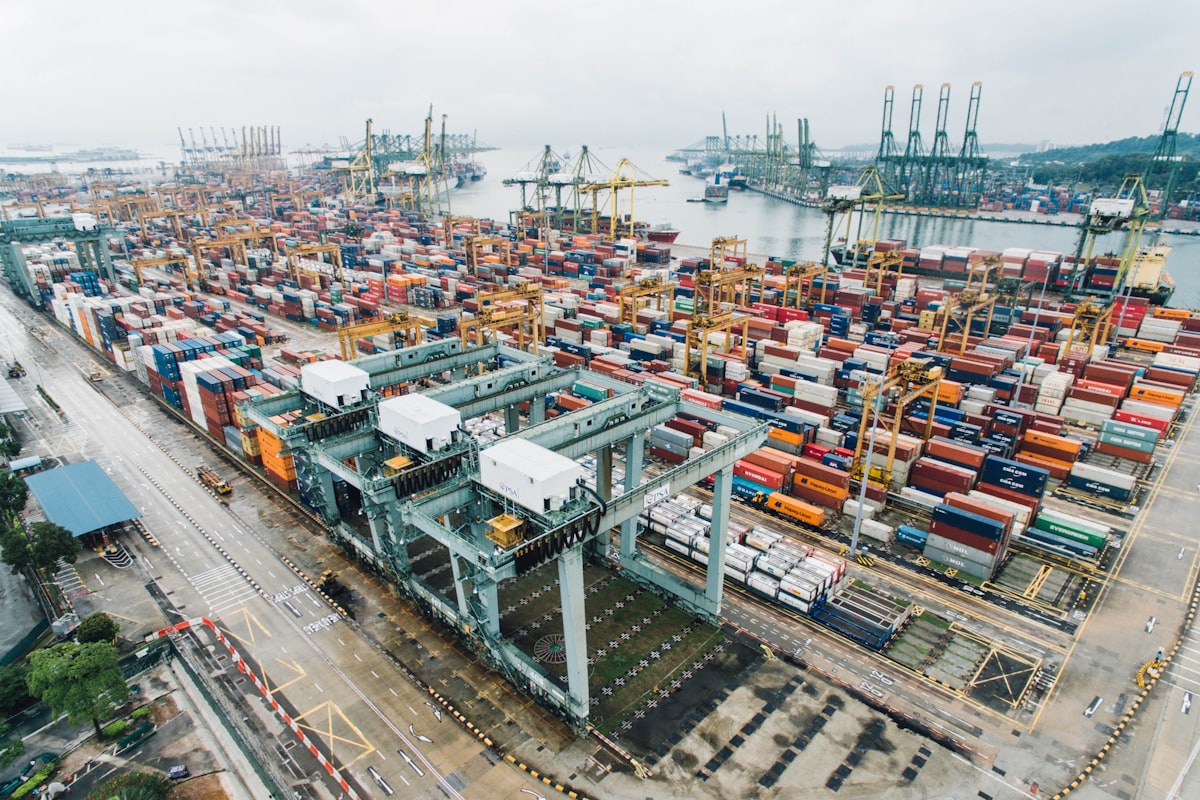
Germany Is Not an Ocean Freight Lane, and Every Rate Sheet Treats It as One
The UK imported GBP 91.7 billion of goods and services from Germany in the four quarters to the end of Q1 2026, up 4.5% on the year before. That made Germany the UK's second largest trading partner, 8.1% of all UK trade. Of the goods inside that number, GBP 18.8 billion was cars, a quarter of the goods the UK imports from Germany. Nobody moves GBP 18.8 billion of cars 20,000 miles. Yet the first quote I was shown for this lane last month opened with an ocean transit time of 20 to 30 days, because the template behind it is a deep sea template. Hamburg to Felixstowe is a short sea crossing and the port pair's own published figure is two days. The real answer for almost every consignment on this corridor is a truck, a ferry and a border post, and the ferry takes 90 minutes.
I keep one simple test for whether a forwarder has actually quoted this lane: I ask for the number of the crossing. Dover handles about two million freight vehicles a year and Calais between 1.6 and 1.8 million heavy goods vehicles, so since February 2026, when DFDS and P and O pooled their freight sailings, a truck can take the next available departure on roughly a 36 minute headway. The Channel Tunnel carried 1,163,124 lorries in 2025 and 104,032 in July 2026 alone. Anybody who answers that question with a vessel name has never loaded a German pallet.
| Option | Transit | Typical load | Who normally quotes it |
|---|---|---|---|
| Groupage or LTL | 4 to 6 business days | 1 to 6 Euro pallets, up to about 3 tonnes | A European groupage network |
| Full truck | 3 to 4 business days, or 2 with a double driver crew | 13.6 m trailer, 24 tonnes, about 33 pallets | An EU road haulier |
| Container, short sea | About 2 days on the sea leg from Hamburg to Felixstowe | 20ft or 40ft where the cargo cannot be palletised | A short sea carrier or NVOCC |
| Air or express | 1 to 3 days | Small, urgent, high value per kilo | An integrator |
The Zero Tariff Is Real, and It Hangs on One Sentence
The EU-UK Trade and Cooperation Agreement was signed on 30 December 2020 and entered into force on 1 May 2021. It provides zero tariffs and zero quotas on goods that comply with the rules of origin. That qualifier is the whole article. A German exporter who puts the right wording on the commercial invoice turns a 10% car tariff into nothing. The same exporter who omits it hands you the full UK Global Tariff, because the third country rate is the default the moment origin is not proven. On cars alone that is roughly GBP 1.9 billion a year of duty across the corridor, and cars are only a quarter of the goods flow.
Here is the part that annoys me. Three of the eleven lines in the table below are at zero duty anyway: medicaments, laptops and wooden furniture. Asking a supplier for a statement on origin for those buys you nothing and costs you a week of emails. On the rest it is worth real money. An 8% or a 12% line on a GBP 40,000 consignment is GBP 3,000 to GBP 5,000 per shipment. The importers whose clearance runs smoothly are the ones who know which lines matter and stop chasing paperwork for the lines that do not.
| Commodity code | Product | UK third country rate | With a statement on origin |
|---|---|---|---|
| 8703.23.19 | Passenger cars, 1,500 to 3,000 cc petrol | 10.00% | 0.00% |
| 6110.20.91 | Knitted cotton pullovers | 12.00% | 0.00% |
| 6403.91.91 | Leather footwear covering the ankle | 8.00% | 0.00% |
| 1806.90.39 | Filled chocolate | 8.00% | 0.00% |
| 3926.90.97.90 | Other articles of plastics | 6.00% | 0.00% |
| 8481.80.99.90 | Taps, cocks and valves | 2.00% | 0.00% |
| 8708.99.97.90 | Motor vehicle parts | 2.00% | 0.00% |
| 8544.42.90.90 | Electric cables fitted with connectors | 2.00% | 0.00% |
| 3004.90 | Medicaments, retail | 0.00% | 0.00% |
| 8471.30 | Portable computers | 0.00% | 0.00% |
| 9403.60.10 | Wooden furniture | 0.00% | 0.00% |
The GBP 1,000 Waiver and the Three Year Refund
There are two ways to prove origin under the agreement. The first is a statement on origin made out by the exporter, in the exact wording in Annex 7, on the invoice or another commercial document. The second is importer's knowledge, meaning your own documented certainty built from the supplier's production records. Small consignments get a break: for imports into the UK, goods worth under GBP 1,000 in total, commercial or non commercial, can be imported without a formal proof of origin at all, provided they are declared as meeting the origin rules. Over that threshold you can only claim the preference on the lines you can actually prove. The EU side of the same waiver is narrower: EUR 500 for small packages, EUR 1,200 in a traveller's personal luggage, and no waiver at all for commercial imports.
If you have already paid the duty, the claim is not lost. A preference claim can be made after importation, as long as it is made within three years of the import date and comes with a valid proof of origin, and any duty is then repaid. In the UK that means a form C285. I filed one for a client who had imported German hydraulic presses on a broker's default entry. The statement on origin had been sitting in the supplier's dispatch email the entire time, the declaration had never cited it, and the refund covered the whole duty line. The lesson was not about customs law. It was that a default entry is a decision, and nobody had made it deliberately.
- Statement on origin: the exporter in Germany writes it, in the Annex 7 wording, on the invoice or another commercial document that describes the products in enough detail to identify them.
- Importer's knowledge: you claim on your own records. It is legal and it holds, but HMRC can ask you to demonstrate it, so the burden sits on you rather than on your supplier.
- On the UK customs declaration the claim appears in specific boxes. DE 2/3 carries U110 for a single shipment, U111 for multiple shipments of identical products across 12 months, or U112 when you are relying on importer's knowledge. DE 4/17 carries a preference code in the 300 series, and DE 5/16 carries the country of preferential origin.
- Keep the proof. Either the statement or the knowledge can be verified after release, and a claim that cannot be supported is recovered, with interest, long after the margin has been spent.
- Consignments worth under GBP 1,000 in total do not need a formal proof of origin for import into the UK, but they still have to be declared as meeting the origin rules.
Four Documents, Four Deadlines, and One of Them Is Not Yours
The paperwork on this corridor splits cleanly between the two ends. On the German side the exporter files an export declaration electronically through ATLAS-Ausfuhr, and because the delivery is an export delivery under section 4, number 1a of the German VAT Act, the supplier invoices it without German VAT. On the UK side you need a GB EORI, an import declaration on CDS and, the one people forget, a safety and security entry summary declaration filed before the vehicle arrives.
The entry summary declaration has a trap built into it, and the trap is responsibility. The legal duty to file sits with the carrier, not with you. For accompanied roll on roll off freight that is the haulage company, for unaccompanied trailers it is the ferry operator, and for road traffic arriving through the Channel Tunnel it is the haulage company again. If your pallet arrives without one, your goods do not move, and arguing that it was somebody else's job does not open the barrier. Then there is GVMS. Any vehicle crossing at a port that uses the Goods Vehicle Movement Service needs a goods movement reference before boarding, and that reference has to contain every declaration attached to the load.
| Document | Who files it | Deadline | What fails without it |
|---|---|---|---|
| EU export declaration, ATLAS-Ausfuhr | German exporter or their agent | Before the vehicle leaves Germany | Goods cannot exit cleanly and the supplier cannot zero rate German VAT |
| Entry summary declaration, S&S GB | Haulier for accompanied freight and Channel Tunnel road traffic, ferry operator for unaccompanied trailers | 2 hours before arrival for roll on roll off and short sea, 1 hour before arrival at Coquelles for the Channel Tunnel, 24 hours before loading for maritime containerised cargo | The vehicle is held at the port until the declaration exists |
| UK import declaration, CDS | Importer or the customs agent acting for them | On or before arrival, under full or simplified procedures | No release into free circulation, so no delivery |
| GVMS goods movement reference | Haulier | Before boarding at the French or Belgian port | No boarding, however good the rest of the file is |
What the Lane Actually Costs in October 2026
Pallet and trailer rates for October 2026 run from EUR 320 for a single Euro pallet to EUR 1,620 for a full 13.6 metre trailer, excluding VAT. The Frankfurt to London leg is about 750 km. Full truck load takes 3 to 4 business days, or 2 with a double driver crew, while groupage and pallets take 4 to 6. The crossover is the number worth memorising: above roughly 8 pallets the trailer is cheaper than groupage, which is where importers quietly lose money by booking pallet by pallet.
One more thing worth knowing before you build a budget. The 900 km of UK road between London and Glasgow adds only EUR 50 to a pallet rate, EUR 330 against EUR 380. Distance inside the UK is not what you are paying for. You are paying for the crossing, the groupage hub and the customs queue. That is also why a delivery address 30 km from Felixstowe is not automatically cheaper than one 300 km away.
| Service | Transit | Typical load | Price from |
|---|---|---|---|
| Groupage, one Euro pallet | 4 to 6 business days | 120 x 80 cm, up to 500 kg | EUR 320 |
| Hamburg to London, one pallet | 4 to 6 business days | 1 Euro pallet | EUR 330 |
| Hamburg to London, three pallets | 4 to 6 business days | 3 Euro pallets | EUR 705 |
| Hamburg to Manchester, three pallets | 4 to 6 business days | 3 Euro pallets | EUR 760 |
| Hamburg to Leeds, three pallets | 4 to 6 business days | 3 Euro pallets | EUR 760 |
| Hamburg to Glasgow, three pallets | 4 to 6 business days | 3 Euro pallets | EUR 820 |
| Groupage, six pallets | 4 to 6 business days | 6 Euro pallets, up to 3 tonnes | EUR 1,340 |
| Full truck, 13.6 m trailer | 3 to 4 business days | 24 tonnes, about 33 pallets | EUR 1,620 |
A Worked Landed Cost: GBP 40,000 from Bavaria to Manchester
Take a mixed consignment from a Bavarian supplier: GBP 15,000 of leather boots, GBP 20,000 of knitted cotton pullovers and GBP 5,000 of wooden office furniture, on one 13.6 metre trailer to Manchester. The freight is EUR 1,620, which is GBP 1,368 at the European Central Bank reference rate of 0.8446 on 13 October 2026, and cargo insurance is GBP 165. The boots sit on an 8% line and the pullovers on a 12% line, which is where the whole argument about origin gets decided. Wooden furniture is zero either way.
Read the two columns against each other. The statement on origin is worth GBP 3,600 on this one trailer, 9.0% of the goods value, and everything else in the file is identical. Landed cost sits at 13.0% above the invoice without it and 4.0% above the invoice with it, once you count freight, insurance and the agent. Note also where the VAT line goes. GBP 9,026.60 at the border if you pay it, and nothing if you postpone it. On a shipment of this size the VAT is more than twice the duty this article spent four sections arguing about.
| Line | Without a statement on origin | With a statement on origin |
|---|---|---|
| Goods, invoice value | GBP 40,000 | GBP 40,000 |
| German export VAT | GBP 0 | GBP 0 |
| Freight, full trailer at EUR 1,620 | GBP 1,368 | GBP 1,368 |
| Cargo insurance | GBP 165 | GBP 165 |
| Customs duty | GBP 3,600 | GBP 0 |
| Leather boots, 8% of GBP 15,000 | GBP 1,200 | GBP 0 |
| Knitted pullovers, 12% of GBP 20,000 | GBP 2,400 | GBP 0 |
| Wooden furniture, zero rated | GBP 0 | GBP 0 |
| Customs agent and clearance | GBP 85 | GBP 85 |
| UK import VAT at 20% | GBP 9,026.60 | GBP 8,306.60 |
| Cash paid at the border without postponement | GBP 12,626.60 | GBP 8,306.60 |
| Cash paid at the border with postponement | GBP 3,600 | GBP 0 |
| Total cost over the invoice | 13.0% | 4.0% |
Postponed VAT Accounting Is Worth 20% of Your Cash, and It Is Not Automatic
Postponed VAT accounting lets a UK VAT registered business declare and recover import VAT on the same VAT return, so the money never leaves the account. There is no approval to apply for, which is exactly why it gets left on the table. There are conditions, and the important one is procedural: you have to tell the person dealing with customs, in writing, that you want it, before the declaration is filed. A forwarder cannot infer it from your VAT number.
The other condition is structural. Postponement covers imports into Great Britain from anywhere outside the UK, but for Northern Ireland it only covers goods arriving from outside the UK and the EU, because Northern Ireland sits inside EU customs rules for those flows. And if you are not registered for UK VAT at all there is nothing to postpone into, so the 20% is a straight cost on the goods, the freight, the insurance and the duty. That is the situation behind most DDP arguments I have sat through. When a German supplier sells you DDP and acts as the importer, they pay that VAT, and if they are not UK VAT registered they cannot recover it. It ends up inside the price you agreed. You get a clean invoice and a permanent 20% of the wrong number.
- You must be registered for VAT in the UK. Without a UK VAT registration there is no return to postpone into.
- No approval is needed, but your customs agent must have your written instruction before they file the declaration.
- A business with no UK establishment has to appoint someone to deal with customs and be named as the consignee on the declaration.
- Postponement covers Great Britain for goods arriving from anywhere outside the UK, and Northern Ireland only for goods from outside the UK and the EU.
- If you can reclaim all your input VAT the net cash effect of a postponed import is zero. If you cannot, postponement does not help and the VAT is a cost.
Northern Ireland Is a Different Customs Country
German goods going to Belfast are not treated like German goods going to Birmingham. Northern Ireland charges customs duty on goods arriving from outside the UK and the EU, and on goods considered at risk of entering the EU, while Great Britain charges it only on goods from outside the UK. The declaration route differs as well. Entry summary declarations for Great Britain go into S&S GB, while for Northern Ireland, including goods coming across from Great Britain, they go into Import Control System 2. Postponed VAT accounting for Northern Ireland only reaches goods arriving from outside the UK and the EU.
I have seen a German pallet booked to a Belfast address on a Dublin freight rate more than once, and it is not always wrong, because it depends whether the goods count as at risk, which the courier will tell you when it applies. But the assumption that a UK import is a UK import is the most common mistake I see on this corridor after the missing statement of origin. If the delivery address ends in BT, do not reuse the England file.
| Great Britain | Northern Ireland | |
|---|---|---|
| Customs duty charged on | Goods arriving from outside the UK | Goods arriving from outside the UK and the EU, and goods at risk of entering the EU |
| Import VAT charged on | All goods except gifts worth GBP 39 or less | Goods arriving from outside the UK and the EU |
| Safety and security declaration filed into | S&S GB | Import Control System 2, or ICS2 |
| Postponed VAT accounting covers | Goods from anywhere outside the UK | Goods from outside the UK and the EU |
| EORI | A GB EORI | An XI EORI for goods moving into Northern Ireland under UK rules |
The Line I Would Change in Every German Quote
The advice I hear most often about this corridor is to buy DDP, hand the clearance to the German supplier and stop worrying about customs. I think that advice costs money in three ways, and I would push back on it every time. First, if the supplier is the importer of record you cannot use postponed VAT accounting, because the VAT is theirs rather than yours, and a supplier without a UK VAT registration cannot recover it either, so it becomes a permanent cost inside the price. Second, the statement on origin is the supplier's document, so in a DDP deal you may never see it and you will never know whether the duty you were charged was zero or the full third country rate. Third, you cannot file a retrospective claim for duty that was never assessed on you.
My counter argument, in fairness, is that DDP genuinely wins when you are buying a handful of items for internal use, when the total consignment is under GBP 1,000 and the waiver means origin proof is not required, or when the German supplier already holds a UK VAT registration and a customs agent they trust. In those cases the administration really is more expensive than the risk. But for anything that repeats, a monthly trailer, a standing purchase order, a product line you will buy for years, I would change one line in the quote from DDP to DAP and add one sentence: a statement on origin per Annex 7 of the Trade and Cooperation Agreement on the commercial invoice. That sentence is worth GBP 3,600 on the GBP 40,000 trailer we costed above, and it costs your supplier about two minutes.
| Handover point | Who is legally on the hook | Where the cost lands |
|---|---|---|
| Collection at the German factory gate | Buyer under FCA, supplier under DAP | Inside the pallet or trailer rate |
| EU export declaration at the German customs office | German exporter | Inside the forwarder's handling fee |
| Loading into the groupage network | Forwarder | Inside the per pallet price |
| Short sea crossing, Calais to Dover or the Channel Tunnel | Haulier | Inside the rate, since the driver's crossing is not invoiced to you separately |
| Entry summary declaration, two hours before arrival | Haulier for accompanied freight, ferry operator for unaccompanied trailers | Inside the agent's fee |
| GVMS goods movement reference before boarding | Haulier | Included in the rate |
| UK import declaration and duty assessment | Importer, or the agent acting for them | The duty plus the agent's fee |
| UK import VAT | Importer | GBP 0 with postponement, otherwise 20% of goods, freight, insurance and duty |
| Final delivery leg inside the UK | Haulier | EUR 330 to London against EUR 380 to Glasgow for the same pallet |

Frequently Asked Questions
Do I pay customs duty on goods shipped from Germany to the UK?
Under the EU-UK Trade and Cooperation Agreement, no, provided the goods meet the rules of origin and you hold a statement on origin or importer's knowledge to support the claim. Without that proof the full UK Global Tariff applies, which on a German passenger car is 10%, on knitted cotton pullovers 12%, on leather footwear covering the ankle 8% and on filled chocolate 8%. Roughly a quarter of the goods the UK buys from Germany are cars, so the tariff is not a rounding error on this corridor.
What is a statement on origin and who writes it?
It is a short declaration in the exact wording set out in Annex 7 of the Trade and Cooperation Agreement, made out by the exporter on the commercial invoice or another commercial document, and it identifies the products and confirms that they originate. The importer can also rely on importer's knowledge instead, which means your own documented evidence rather than the supplier's statement. Either way the proof has to be kept, because it can be verified after the goods are released.
How long does shipping from Germany to the UK take?
Groupage and pallet traffic takes 4 to 6 business days, and a full 13.6 metre trailer takes 3 to 4 business days from Frankfurt to London, or 2 days with a double driver crew. The short sea container leg from Hamburg to Felixstowe is published as roughly 2 days. If a quote tells you 20 to 30 days for this lane, it is a deep sea template that has not been adjusted for a corridor with a 90 minute ferry crossing.
Can I postpone UK import VAT if my company is not established in the UK?
You need a UK VAT registration to use postponed VAT accounting, because the mechanism works by declaring and recovering the import VAT on your own VAT return. A business with no UK establishment must also appoint someone to deal with customs and be named as the consignee on the import declaration, and that agent must have your written instruction before they file it. If you have no UK VAT registration the 20% becomes a real cost on the goods, the freight, the insurance and the duty.
Is shipping from Germany to Northern Ireland treated the same as to Great Britain?
No. Northern Ireland charges customs duty on goods arriving from outside the UK and the EU and on goods considered at risk of entering the EU, while Great Britain charges it only on goods from outside the UK. Entry summary declarations for Northern Ireland go into Import Control System 2 rather than S&S GB, and postponed VAT accounting for Northern Ireland only covers goods arriving from outside the UK and the EU.
Written by Ace Wang
Founder & Import Operations Specialist
Ace Wang has spent 20 years in cross-border ecommerce operations, managing import supply chains for small and medium businesses. From the early days of Alibaba sourcing to modern multi-country logistics strategies, Ace has helped hundreds of entrepreneurs navigate customs clearance, shipping optimization, and landed cost management. The LandedCostHub calculator and all content on this site are built on real-world experience — not textbook theory. Ace believes that transparent, accurate cost data is every importer's right, not a professional service luxury. More about Ace Wang →
Main departure hubs in Germany
Most Germany export freight moves through Hamburg, Bremerhaven. The hub you book from drives transit time, departure frequency and often the rate itself — two gateways in the same country can differ by hundreds of dollars on a container.
Sea freight loads at the container port, air freight at the international airport. Ask your forwarder which hub the quote is based on before comparing rates.
Import cost on key routes
View shipping rates, duty rates, and total landed cost estimates.
Calculate Your Total Landed Cost
Use our free calculator to estimate your total import costs including duties, shipping, and taxes.
Related Guides
Sea vs Air vs Express Shipping: Which Method Should You Choose?
Compare sea freight, air freight, and express courier shipping costs and transit times for your import business.
Read More →FCL vs LCL Shipping: Which Container Option Saves You Money?
Compare Full Container Load vs Less than Container Load shipping. Find the most cost-effective option for your cargo volume.
Read More →Shipping from China: Complete Cost Breakdown for 2026
Detailed breakdown of shipping costs from China. Compare sea freight, air freight, and express courier pricing with real examples.
Read More →Popular Routes
Calculate import costs from this country.