Importing from China to the UK 2026: Duty, VAT, Freight
Updated: 2026-10-01
Four Ways to Move the Same Pallet Out of China, Compared
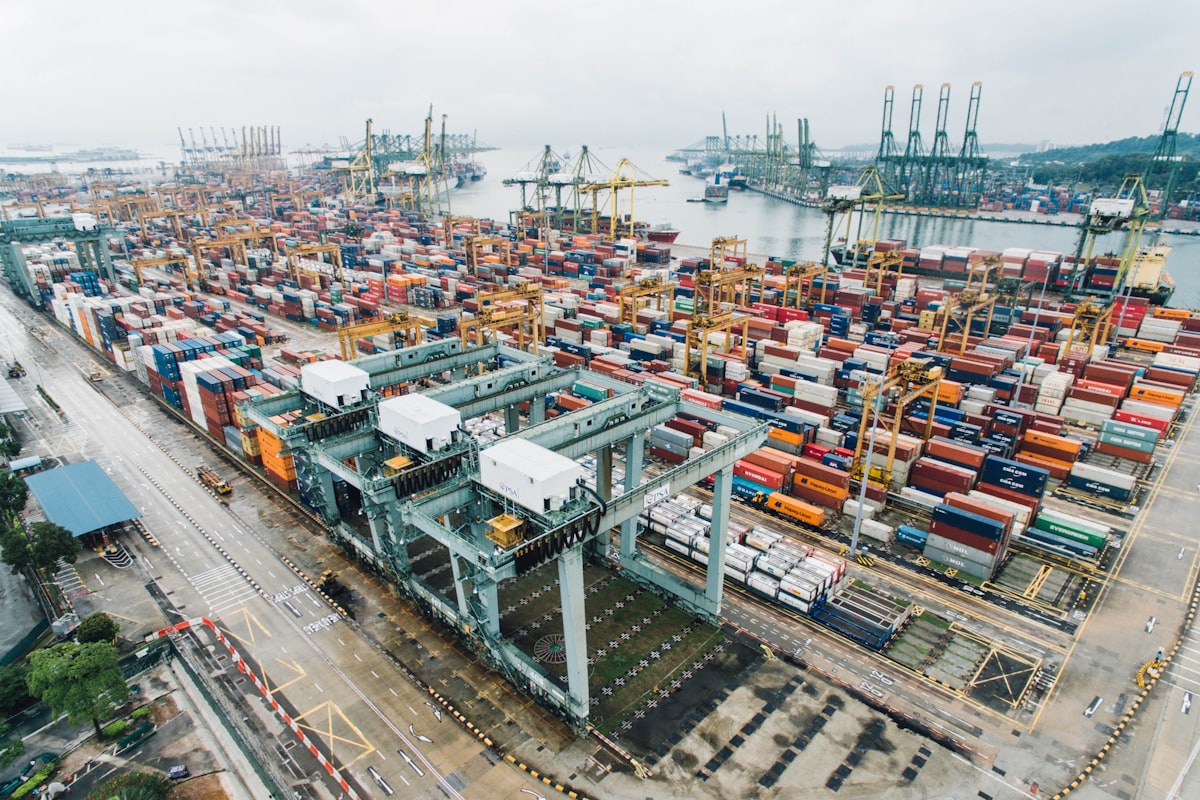
A container out of China reaches the UK through four doorways, and they are not close substitutes. Full container load ships from Shanghai, Ningbo, Shenzhen or Qingdao into Felixstowe, London Gateway, Southampton or Liverpool. Less than container load shares that space. Air freight flies out of Shanghai Pudong or Shenzhen into Heathrow, Gatwick or Stansted. Express couriers use the same aircraft and sell you a different service. On 1 October 2026 a 20ft box from Shanghai to Felixstowe was quoted at GBP 1,834 on the cheapest sailing and GBP 4,720 on the most expensive, same port pair, same month. That spread is wider than most duty lines, which is why mode selection gets all the attention. It is also why most people compare the wrong number. Every rate and every duty figure in this article comes from the UK Trade Tariff or a carrier rate feed checked on 1 October 2026.
I have booked this lane often enough to have a routine. I pull three quotes, one port to port and two door to door, then I write the duty and the VAT next to each one before I look at transit time. The last consignment I helped price was 1.8 cubic metres of kitchen gadgets out of Ningbo, small enough that LCL was obviously right. The ocean leg came in at USD 164. The UK destination charges, the deconsolidation fee and the CISF line that nobody quotes up front, came to GBP 340. The freight was not the expensive part of the freight. Once I started writing the whole bill on one page, the mode argument stopped being interesting and the classification argument started.
| Option | Rate you will see | Door to door | Best for | The trap |
|---|---|---|---|---|
| FCL, 20ft | GBP 1,834 to GBP 4,720, Shanghai to Felixstowe, 1 October 2026 | 31 to 40 days | Dense cargo, 20 to 25 CBM | You pay for the box even if it is half empty |
| FCL, 40ft or 40HC | GBP 2,744 to GBP 6,201 | 31 to 40 days | Furniture, textiles, bulky goods | A 40ft only pays off above about 55 CBM of actual cargo |
| LCL | USD 80 to USD 150 per CBM, 1 CBM minimum | 45 to 60 days | Test orders under 12 to 15 CBM | CISF and destination handling can exceed the ocean leg |
| Air freight | USD 5.00 to USD 8.00 per kg | 3 to 5 days | High value, time critical, under 500 kg | Volumetric weight punishes anything bulky |
| Express courier | Priced per kg with a parcel floor | 2 to 4 days | Samples and replacements | Nothing above GBP 135 ships free of duty, so your buyer pays the bill |
The Three Numbers That Beat the Freight Rate
Duty and VAT sit on top of the goods value, and in the UK they stack rather than run in parallel. Import VAT is charged on the customs value plus the duty, so a duty line that looks small drags a VAT line with it. Take three consignments of similar effort and different codes. GBP 20,000 of cotton T-shirts out of Guangzhou, code 6109.10, carries 12% duty, which is GBP 2,400, and 20% VAT on the resulting GBP 22,400, which is GBP 4,480. The tax bill is GBP 6,880, or 34.4% of the goods value. GBP 30,000 of laptops, code 8471.30, carries no duty at all, and 20% VAT on GBP 30,000 is GBP 6,000. Zero duty is a real saving, and it is not zero tax. The third consignment is the one that ends careers, and it lives in the anti-dumping section further down, because the mug code has a measure attached that has nothing to do with the tariff.
Here is the number I use when somebody tells me duty is 4%, so it does not matter. On a GBP 12,000 order of stoneware mugs, code 6912.00, the third country duty is 4%, or GBP 480, and import VAT is 20% of GBP 12,480, which is GBP 2,496. Total GBP 2,976, about 24.8% of the goods. Now add the anti-dumping measure the tariff book applies to Chinese ceramics at 17.9% for the exporters on the long list. The duty becomes GBP 2,628 instead of GBP 480, the VAT base becomes GBP 14,628, and the total tax bill is GBP 5,553.60. If your supplier is on no list at all and the residual 36.1% applies, the same order clears at GBP 8,174.40, or 68.1%. The difference between two suppliers quoting the same FOB price is GBP 2,620.80, more than the ocean freight on the entire consignment.
| Consignment | Code | Duty | Import VAT at 20% | Total tax | Share of goods value |
|---|---|---|---|---|---|
| GBP 20,000 cotton T-shirts | 6109.10.0010 | GBP 2,400 at 12% | GBP 4,480 | GBP 6,880 | 34.4% |
| GBP 30,000 laptops | 8471.30.0000 | GBP 0 at 0% | GBP 6,000 | GBP 6,000 | 20.0% |
| GBP 12,000 stoneware mugs, listed exporter | 6912.00.2111 | GBP 2,628, being 4% plus 17.9% | GBP 2,925.60 | GBP 5,553.60 | 46.3% |
| GBP 12,000 stoneware mugs, residual rate | 6912.00.2111 | GBP 4,812, being 4% plus 36.1% | GBP 3,362.40 | GBP 8,174.40 | 68.1% |
The Same Code, Two Tariffs: Where the UK Drops Below the EU
The UK Global Tariff is not a copy of the EU common external tariff, and the differences run in both directions. Toys under code 9503 carry 4.0% in the UK, while the same heading sits at 4.7% on the EU side. Ceramic tableware under 6912.00 is 4.0% here. Cotton T-shirts at 6109.10 are 12.0% in both. Leather footwear under 6403 is 8.0%. Laptops and smartphones are zero in both. If you sell into both markets you cannot carry one duty table in your head, and you cannot copy an EU quotation into a UK order without checking it. The rate also sets your VAT base, so a 0.7 point tariff difference on toys moves the total tax by 0.84 points of value, because the 20% is charged on a figure that already contains the duty.
The tariff rate is the least negotiable number in the entire purchase. You can argue with a forwarder about a GBP 300 surcharge, you can argue with a supplier about the FOB price, and you can argue with nobody about a 10 digit code. What you can do is check the code on the day you quote, because the same product can land in two headings that differ by eight percentage points, and a binding tariff ruling costs you nothing but 30 days. The table below is the set of rates I end up quoting most often on this lane, pulled from the UK Trade Tariff on 1 October 2026.
| Goods | UK third country duty | What people assume |
|---|---|---|
| Toys, 9503 | 4.00% | About 5% |
| Cotton T-shirts, 6109.10 | 12.00% | A few percent |
| Women's dresses, 6204 | 12.00% | A few percent |
| Bed linen, 6302.10 | 12.00% | Textiles are duty free |
| Jerseys and pullovers, 6110 | 10.00% to 12.00% | One flat textile rate |
| Leather footwear, 6403 | 8.00% | The old EU footwear number |
| Ceramic tableware, 6912.00 | 4.00% | Anything between 4% and 12% |
| Wooden and metal furniture, 9403 | 0.00% | Furniture is taxed |
| Smartphones, 8517.13 | 0.00% | Electronics carry a duty |
| Laptops, 8471.30 | 0.00% | Same |
| Passenger cars, 8703.23 | 10.00% | The EU 10% does not apply here |
| Scooters, 8711.20 | 8.00% | Two wheelers are duty free |
The Lines Where the Tariff Book Says China Out Loud
A third country duty is one number for every country without a trade agreement. A trade remedy measure is different: it names a country or a company, and it stacks on top. Ceramic tableware and kitchenware from China carries a definitive anti-dumping duty in the UK under trade remedies notice 2025/21, which took effect on 26 November 2025 and supersedes taxation notice 2020/30. The measure runs to 16 July 2029, with an expiry review before then. The rates are 13.1% for Guangxi Sanhuan Enterprise Group Holding, 18.3% for the Hunan Hualian companies, 17.6% for the eight firms in annex 2, 17.9% for the 392 firms in annex 3, and 36.1% for every other exporter. The duty applies to the net, free-at-the-frontier price before other import duties, which means it stacks with the 4% third country duty instead of replacing it.
Folding e-bikes are the other measure worth knowing, because the range is so wide. Under trade remedies notice 2025/3 the rates run from 10.3% for Jinhua Vision and Yongkang Hulong to 70.1% for the exporters in annex 3, with 62.1% as the residual rate. I once watched a client save GBP 9,000 by asking one question: are we on the list. The supplier was, at 10.3%, and the broker had priced the residual. That is the good version of this story. Now the trap, which taught me to read every measure twice. The tariff book shows additional duties of 35% against plastic tableware under 3924.10, and at a glance it looks like a China measure. It is not. Those 35% measures name Russia and Belarus. The China rate on that code is the plain 6% third country duty. A measure has a country dimension, and if you read the code without reading the country you will quote a number that does not exist.
| Measure | Goods | Rate | In force |
|---|---|---|---|
| Anti-dumping duty, trade remedies notice 2025/21 | Ceramic tableware and kitchenware from China, 6912 | 13.1% to 18.3% for named exporters, 17.6% for annex 2, 17.9% for annex 3, 36.1% residual | 26 November 2025 to 16 July 2029 |
| Anti-dumping duty, trade remedies notice 2025/3 | Folding e-bikes from China, 8711.60 | 10.3% to 70.1% by exporter, 62.1% residual | In force, periodically reviewed |
| Additional duties, 3924.10 | Plastic tableware | 35.00% | Russia and Belarus only, not China |
The GBP 135 Line, and What the UK Did Instead of a Flat Fee
The UK scrapped low value consignment relief in January 2021, so VAT applies from the first pound on imports from China, with two exceptions. Gifts worth GBP 39 or less are not charged VAT. For a consignment worth GBP 135 or less that you buy yourself, and that is not excise goods, the seller is expected to include the VAT in the price you pay, which means the seller has to be registered for UK VAT. Above GBP 135 the duty becomes payable, at the rate for the goods and the origin, and the import VAT moves to the delivery company. If your goods are worth more than GBP 135 you pay the VAT to the courier before delivery or on collection, and it is charged on the goods, the postage, the packaging, the insurance and any duty you owe. Royal Mail, Parcelforce or the courier holds the parcel for about three weeks, then sends it back.
This is where the UK and the EU have genuinely diverged. From 1 July 2026 the EU charges a flat EUR 3 duty for each declared tariff line on distance sales up to EUR 150, and leaves the import VAT to the IOSS or the special arrangements. Nothing like that applies to a Chinese parcel arriving in the UK. There is no flat fee to plan for and no EUR 3 ceiling, so the customs bill on a GBP 140 parcel is the seller's VAT, and on a GBP 900 parcel it is real duty plus 20% VAT on a value that includes the freight. The UK system is simpler to explain to a supplier. The EU system is cheaper on a mixed cart. Both sentences are true, and that is the whole difference between the two regimes.
| Consignment | VAT | Customs duty | Who collects it |
|---|---|---|---|
| Gift worth GBP 39 or less | None | None | Nobody |
| Goods you bought, GBP 135 or less, not excise | Included by the seller in the price | None | The seller, if registered for UK VAT |
| Gift worth more than GBP 39 | Import VAT from the first pound | None below GBP 135 | The delivery company |
| Goods worth more than GBP 135 | 20% standard rate on value, freight, insurance and duty | At the rate for the code and origin | The courier, or your agent if you are a business |
| Excise goods, any value | Yes | Yes | The courier |
Four Freight Numbers for One Sailing, and Why They Never Match
On 1 October 2026 a Shanghai to Felixstowe sailing was quoted at GBP 1,834 for a 20ft container on the cheapest service, GBP 2,744 for a 40ft or 40HC, and GBP 4,720 for the most expensive 20ft, all at a 31 day transit. A forwarder's own estimate for the same lane in early 2026 puts a 20ft at USD 2,500 to USD 3,500 and a 40ft at USD 4,500 to USD 6,500. LCL runs at USD 80 to USD 150 per CBM with a one cubic metre minimum, and air freight at USD 5.00 to USD 8.00 per kg. Then come the surcharges: a bunker adjustment factor, a war risk surcharge, and carbon pricing of roughly USD 20 to USD 40 per TEU on UK calls. On LCL you also meet the destination handling charge, sold in the UK under the name CISF. My rule is that a port to port quote and a door to door quote are different products, and I never compare them without labelling which is which.
The two numbers I check before anything else are the insurance rate and the free time. Insurance on this lane is usually 0.3% to 0.5% of cargo value, cheap enough that people forget it and expensive enough to notice when a claim goes wrong. Free time at the port is 5 to 7 days, after which storage and equipment charges run at over GBP 100 a day. A GBP 3,000 container that sits a week past its free days carries a surcharge of more than 20% that no freight negotiation can undo. Both of those lines are more predictable than the headline rate, and both of them are missing from the quote most first time importers accept.
| Line | Typical range | Fixed or negotiable |
|---|---|---|
| FCL 20ft, Shanghai to Felixstowe | GBP 1,834 to GBP 4,720, 31 days | Negotiable, moves weekly |
| FCL 40ft or 40HC | GBP 2,744 to GBP 6,201, 31 days | Negotiable, moves weekly |
| LCL | USD 80 to USD 150 per CBM, 1 CBM minimum | Negotiable, plus CISF at destination |
| Air freight | USD 5.00 to USD 8.00 per kg, 3 to 5 days door to door | Negotiable, volumetric weight applies |
| Insurance | 0.3% to 0.5% of cargo value | Fixed percentage |
| Carbon and surcharges | About USD 20 to USD 40 per TEU, plus bunker and war risk | Fixed, outside your control |
Transit Time in 2026: the Cape, the Truck Slot and Five Free Days
The transit number on your quote depends on which way the ship goes. Before the Red Sea disruption, Shanghai to Felixstowe was a 30 to 35 day sailing through Suez. In 2026 most carriers route around the Cape of Good Hope, which adds roughly 3,500 nautical miles and about 15 days, so the practical range is 40 to 55 days to Felixstowe, 38 to 50 to Southampton, and 42 to 58 to London Gateway. Air freight from Shanghai Pudong to Heathrow is a 3 to 5 day door to door service. Two things reliably add days at the UK end: a transshipment through Singapore, Tanjung Pelepas or Rotterdam, worth 7 to 10 days, and the vehicle booking system at Felixstowe, where the truck slot can be the bottleneck rather than the vessel.
Felixstowe handles more than 48% of the UK's containerised trade, so when it is busy, the whole country is busy. I now add ten days to every carrier ETA when I plan, and I pre-lodge the declaration while the box is still on the water. The last time I skipped that step a client's container cleared without a problem and then sat four days waiting for a slot, which is four days of storage on a product with a short season. The four days of storage cost more than the GBP 198 gap between the cheapest and the fastest 20ft sailing on that lane on 1 October 2026, and it never appeared in anyone's spreadsheet until the invoice did.
| Leg | 2026 transit | What stretches it |
|---|---|---|
| Shanghai to Felixstowe, sea | 40 to 55 days | Cape routing, blank sailings, truck slots |
| Shanghai to Southampton, sea | 38 to 50 days | Less congestion, longer inland haul |
| Shanghai to London Gateway, sea | 42 to 58 days | Fewer direct services |
| Shanghai Pudong to Heathrow, air | 3 to 5 days door to door | Volumetric weight, screening, peak season |
| Any LCL consignment | Add 7 to 10 days against FCL | Consolidation and deconsolidation |
The Declaration Side: EORI, CDS and the Documents That Stop a Container
You need an EORI number starting with GB to import into England, Wales or Scotland, and a separate one starting with XI for movements involving Northern Ireland. All declarations now go through the Customs Declaration Service, which replaced the old CHIEF system, and a declaration needs a ten digit commodity code before it can be lodged. The four documents that stop a container when they are wrong are the commercial invoice with the Incoterm and the value, the packing list with gross and net weights, the bill of lading or air waybill, and the classification itself. If you store goods in the UK on behalf of sellers outside the UK, you may also need to register under the Fulfilment House Due Diligence Scheme.
Postponed VAT accounting is the one UK mechanism I would put into every first import plan. It lets you declare and recover import VAT on the same VAT return instead of paying it at the border and reclaiming it weeks later, and it needs no approval, only a UK VAT registration. Two conditions matter. You have to tell your customs agent in writing that you want it, before the declaration is lodged. And if you are not established in the UK you cannot simply do it alone: you need someone to deal with customs on your behalf, and they have to enter your details as consignee. On a GBP 40,000 consignment of zero duty goods the import VAT is GBP 8,000, so keeping that out of the border payment is a cash flow decision rather than a tax saving.
- Invoice with the Incoterm, the unit price and a full description of the goods
- Packing list with gross and net weights and carton dimensions
- Bill of lading or air waybill in the name of the importer
- Ten digit commodity code, checked against the UK Trade Tariff on the day you quote
- GB EORI, or XI if Northern Ireland is involved
- Written instruction to your agent if you want postponed VAT accounting
Three Cargo Profiles, Three Verdicts
Mode selection stops being a debate once you describe the cargo honestly. Dense goods, metal fittings, tools, liquids, go in a 20ft container because you run out of weight before you run out of space. Light bulky goods, furniture, textiles, flat packed anything, go in a 40HC because you are buying volume. High value electronics or fashion with a two week window go by air, and USD 5.00 to USD 8.00 per kg is cheap compared with a missed season. Small first orders go LCL, but only once you have the CISF number in writing before you book. The table below is the version of that decision I actually use, with the check that has burned me or a client at least once.
My verdict on this lane is that the freight rate is the least important number on it and the classification is the most important. The consignments in the table at the top of this article take the same effort to move, and their tax bills run from 20% to 68% of goods value before a single container is booked. That is not a freight problem, and no forwarder can solve it. What I do instead is fill in one page before every booking, the same twelve lines, and if any line is blank I do not sign the purchase order. Here are the twelve lines, and the two numbers I never guess: the commodity code, and the anti-dumping status of the supplier.
- FOB price and currency, converted at the rate you will actually pay
- Ocean or air freight, port to port, with the surcharge lines separated
- Insurance, as a percentage and as an amount
- Ten digit commodity code, verified on the UK Trade Tariff today
- Third country duty, as a percentage and as an amount
- Anti-dumping or countervailing measure, by exporter, with the notice number
- Customs value, being goods plus freight plus insurance
- Import VAT at 20% on the customs value plus the duty
- Destination handling, CISF, terminal and agent fees
- Inland delivery and the truck slot booking
- Free time at the port, and the daily charge after it expires
- Whether postponed VAT accounting is on the declaration, and who instructed the agent
| Your cargo | What I would book | Why | Check first |
|---|---|---|---|
| Dense, 20 to 25 CBM or heavy per CBM | FCL 20ft | You run out of weight before volume | The 20ft rate on the cheapest sailing, not the fastest |
| Light and bulky, 55 to 68 CBM | FCL 40HC | You are buying volume, and 40HC cost the same as 40ft here | Whether 40ft and 40HC are priced identically, which they were on 1 October 2026 |
| Under 12 CBM, first order | LCL | Paying for space you use beats paying for a box you cannot fill | The CISF figure, in writing |
| Under 500 kg, high value, deadline | Air freight | USD 5.00 to USD 8.00 per kg beats a missed season | Volumetric weight before you agree a rate |
| Ceramics, e-bikes, steel, textiles | Any mode, but price the measure first | The anti-dumping measure can exceed the freight | The notice number and your exporter's rate |

Frequently Asked Questions
Do I pay customs duty on goods worth less than GBP 135 from China?
For non-excise goods worth GBP 135 or less that you buy yourself, there is no customs duty, and the seller is expected to include the VAT in the price, which means the seller needs a UK VAT registration. Gifts worth GBP 39 or less escape VAT as well. Above GBP 135 the duty appears at the rate for the code and origin, and the import VAT moves to the courier. The GBP 135 line is the duty threshold and the point where the seller stops being the VAT collector. It is not a duty free allowance for a business buying stock.
Two suppliers quote the same price for ceramic mugs. Why is one bill 40% higher?
Because the anti-dumping duty is set per exporter. Under trade remedies notice 2025/21, ceramic tableware from China carries 13.1% for one company, 18.3% for another group, 17.6% for eight firms, 17.9% for 392 firms, and 36.1% for everyone else. The duty applies to the net, free-at-the-frontier price and stacks with the 4% third country duty. On a GBP 12,000 order the gap between the 17.9% list and the residual rate is GBP 2,620.80 of tax. Ask which additional code the consignment will be declared under, and check it before you sign.
Is import VAT charged on the freight as well as the goods?
Yes. Import VAT is 20% of the customs value plus the duty, and the customs value includes freight and insurance to the UK. That is why the carbon surcharge and the bunker adjustment factor matter to your tax position, and why a bulkier consignment is effectively taxed twice, once by the carrier and once by HMRC. Where the duty is zero the base is simply the customs value, so VAT still applies. Zero duty has never meant zero tax on this lane.
Can I avoid paying import VAT at the border?
If you are registered for UK VAT you can use postponed VAT accounting and declare the import VAT on your VAT return instead of paying at the border, and you do not need approval for it. You do have to give your customs agent written instructions before the declaration is lodged. If you are not established in the UK you need someone to deal with customs on your behalf, and they must enter your details as consignee. With full deduction rights the import VAT nets out, but it is a cash flow benefit rather than a tax saving.
Why does my forwarder quote 30 days when this article says 40 to 55?
The 30 day figure comes from Suez routing, which is what a lot of quotes still assume. In 2026 most Asia to Europe services go around the Cape of Good Hope, which adds about 3,500 nautical miles and roughly 15 days, so Shanghai to Felixstowe is realistically 40 to 55 days and London Gateway 42 to 58. Add 7 to 10 days if your cargo is transshipped, and add the time needed for a truck slot at Felixstowe. Ask which routing the quoted transit assumes, and get the answer in writing, because the difference is not a rounding error.
Written by Ace Wang
Founder & Import Operations Specialist
Ace Wang has spent 20 years in cross-border ecommerce operations, managing import supply chains for small and medium businesses. From the early days of Alibaba sourcing to modern multi-country logistics strategies, Ace has helped hundreds of entrepreneurs navigate customs clearance, shipping optimization, and landed cost management. The LandedCostHub calculator and all content on this site are built on real-world experience — not textbook theory. Ace believes that transparent, accurate cost data is every importer's right, not a professional service luxury. More about Ace Wang →
Main departure hubs in China
Most China export freight moves through Shanghai, Shenzhen, Ningbo, Guangzhou. The hub you book from drives transit time, departure frequency and often the rate itself — two gateways in the same country can differ by hundreds of dollars on a container.
Sea freight loads at the container port, air freight at the international airport. Ask your forwarder which hub the quote is based on before comparing rates.
Import cost on key routes
View shipping rates, duty rates, and total landed cost estimates.
Calculate Your Total Landed Cost
Use our free calculator to estimate your total import costs including duties, shipping, and taxes.
Related Guides
Sea vs Air vs Express Shipping: Which Method Should You Choose?
Compare sea freight, air freight, and express courier shipping costs and transit times for your import business.
Read More →FCL vs LCL Shipping: Which Container Option Saves You Money?
Compare Full Container Load vs Less than Container Load shipping. Find the most cost-effective option for your cargo volume.
Read More →Shipping from China: Complete Cost Breakdown for 2026
Detailed breakdown of shipping costs from China. Compare sea freight, air freight, and express courier pricing with real examples.
Read More →Popular Routes
Calculate import costs from this country.
China → Switzerland
View import costs and calculator
China → Saudi Arabia
View import costs and calculator
China → South Africa
View import costs and calculator
China → Turkey
View import costs and calculator
China → Kenya
View import costs and calculator
China → Egypt
View import costs and calculator
China → Chile
View import costs and calculator
China → Colombia
View import costs and calculator
China → Peru
View import costs and calculator