Importing from Vietnam to the EU: Duty, VAT and Freight 2026
Updated: 2026-10-02
The tariff number most buyers get wrong: 85.6% became 99.2%
The EU-Vietnam Free Trade Agreement (EVFTA) has been in force since 1 August 2020. On day one the EU removed duties on 85.6% of tariff lines for Vietnamese goods, which covered 70.3% of Vietnam's export value to Europe. Within seven years the EU reaches 99.2% of tariff lines and 99.7% of export value. The last of those seven-year cuts land on 1 January 2027. What stays outside the deal is small: roughly 0.3% of lines, mostly rice, sweet corn, garlic and sugar, which come in under tariff-rate quotas rather than free.
I priced a 40-foot container of acacia and rattan dining furniture out of Binh Duong in June. The EU common external tariff on the lines I was using sat between 2.7% and 6%. With a movement certificate EUR.1 issued through Vietnam's eCoSys system, the duty line came back at zero on 14,690 EUR of customs value, which took about 400 EUR off the bill before VAT. That is what the agreement is worth when the paperwork is right. When it is wrong you pay the tariff rate and you pay VAT on top of the tariff.
| Product group | EU duty at entry into force | Position in October 2026 | Final cut |
|---|---|---|---|
| Textiles and garments | 77.3% of export value at 0% within 5 years | Most lines at 0%, residual tail still paying | 1 January 2027 |
| Footwear | 42.1% of export value at 0% | 73.2% at 0% after 3 years, tail remains | 1 January 2027 |
| Wood and wood products | 83% of tariff lines at 0% (previous duties 2-10%) | Remaining 17% phased over 3-7 years | 1 January 2027 |
| Seafood | 86.5% of export value at 0% within 3 years | Elimination complete | 1 January 2027 |
| Roasted coffee and coffee extracts | Previously 7-11% | 0% since 1 August 2020 | Done |
| Honey, fruit and vegetables | Full elimination from day one | 0% since August 2020 | Done |
| Rice, sweet corn, garlic, sugar | Not liberalised | 0% only inside quota (80,000 t rice, 100,000 t broken rice) | Quota only |
Two port clusters do almost all the work, and they are 1,600 km apart
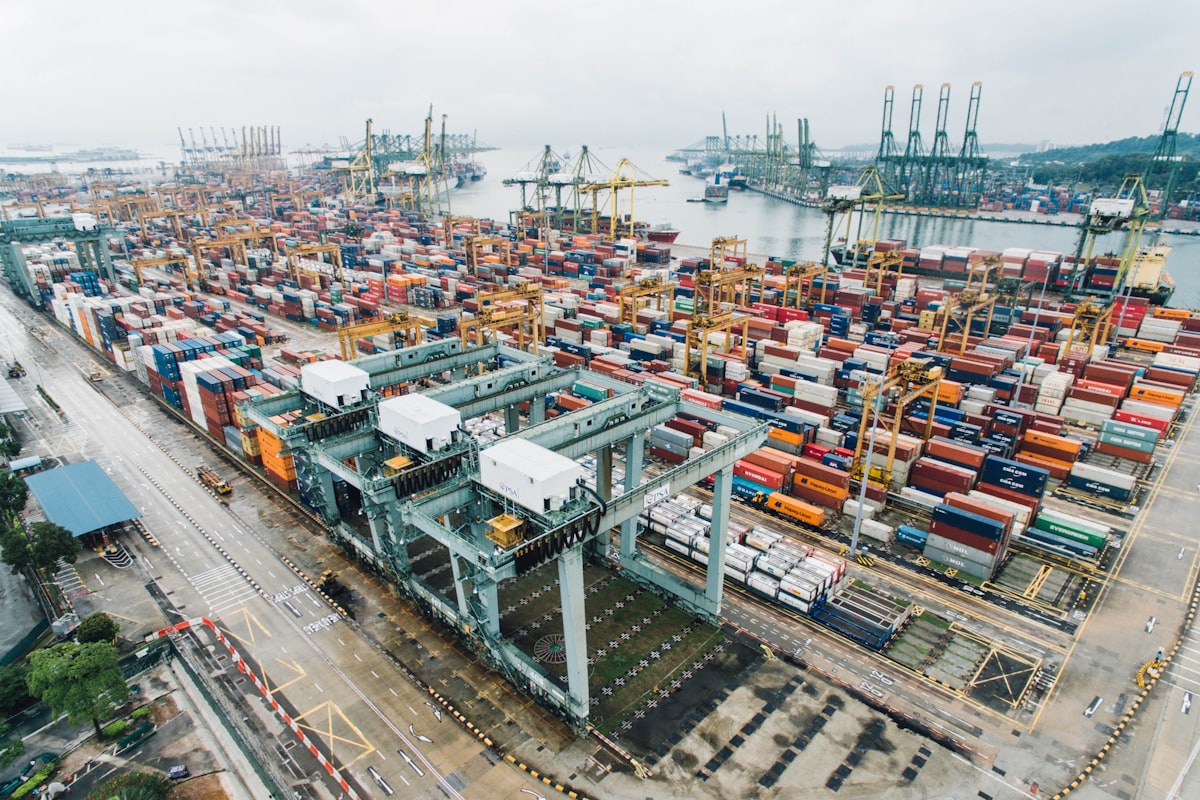
Vietnamese container exports leave through two clusters, and they are not interchangeable. In the south, Cai Mep-Thi Vai sits about 60 km south-east of Ho Chi Minh City and 30 km north-west of Vung Tau. It is the only place in the country that regularly takes the largest deep-sea ships, with berths rated for vessels up to 200,000 DWT and terminals TCIT, CMIT, SSIT and Gemalink. That is where the direct North Europe strings call. In the north, Hai Phong handled 5,695,839 TEU in 2024 and ranked 32nd on Lloyd's List of the world's top container ports. The Lach Huyen island terminal, roughly 40 km east of the city and linked by bridge, added berths 3 and 4 in a joint venture with MSC during 2025, and since May 2025 Vietnam allows Lach Huyen to take ships up to 165,000 DWT.
I made the classic mistake on my first Vietnam order. I let the supplier choose the port because it was nearest his factory in the north, then wondered why the rate I had budgeted from Ho Chi Minh had grown by about 900 USD. The box was sailing from Hai Phong, which is a different lane with different carriers and a different rate card. If the factory is in Binh Duong, Dong Nai, Long An or Ho Chi Minh City, the cargo goes south. If it is in Hanoi, Bac Ninh or Hai Duong, it goes north. Ask which port before you ask for a rate.
- Cai Mep-Thi Vai (south): deep water, big ships, the direct Europe strings. Right for Binh Duong, Dong Nai, Long An and Ho Chi Minh City.
- Cat Lai (south, on the Saigon river): river draft limits, feeder and intra-Asia services, cheaper terminal handling but usually a transhipment before Europe.
- Hai Phong and Lach Huyen (north): the gateway for the Red River Delta manufacturing belt. Ranked 32nd in the world by container volume in 2024.
- Da Nang (centre): the third cluster by size and a poor fit for full containers heading to North Europe. It is a feeder play.
- The two main clusters are roughly 1,600 km apart by road. Never treat a Hai Phong quote and a Cai Mep quote as two prices for the same thing.
What the freight actually costs out of Vietnam
Freight is where the variance lives. Two ports in the same country can differ by hundreds of dollars per container, and the same lane quoted door-to-door instead of port-to-port can nearly double. The table below is the lane I have watched most closely, Cai Mep and Ho Chi Minh City to Rotterdam, using 2025-2026 market ranges.
Two transit numbers for the same lane is normal and it is not a trick. Our own Vietnam to Netherlands route page quotes Ho Chi Minh City to Rotterdam at 22-28 days, because that is the fastest direct string with no transhipment. A forwarder quoting 29-47 days is usually pricing a door-to-door service that adds inland collection, a transhipment in Singapore or Algeciras, or routing around the Cape of Good Hope. Before you compare quotes, check whether each one ends at Rotterdam or at your warehouse. The other swing factors are bunker surcharges, Cai Mep congestion around Tet, and container imbalance, since it is still usually cheaper to export from Asia than to ship back into it.
- Quotes diverge most on what is included: origin haulage, terminal handling, BAF, and the destination delivery leg.
- August to October is the peak window into Europe. Rates and space both tighten.
- A 40HC usually beats two 20ft containers once you are past about 30 CBM, but check the weight limit before you assume it.
- LCL looks cheap per CBM until you add the destination CFS charges, which are charged per shipment, not per CBM.
| Mode | Transit | Rate (Ho Chi Minh to Rotterdam) | When it makes sense |
|---|---|---|---|
| Ocean FCL, 20ft | 22-28 days on the fastest direct strings, 29-47 with transhipment or Cape routing | USD 1,300-3,800 per container | Most cargo above 12 CBM |
| Ocean FCL, 40ft or 40HC | Same windows | USD 2,000-5,100 per container | 55-65 CBM of low-density goods |
| Ocean LCL | 46-71 days | USD 90-200 per CBM | Under 8-12 CBM and no time pressure |
| Air freight | 3-8 days | USD 3-15 per kg | Samples, seasonal top-ups, high value density |
| Express courier | 3-7 days | USD 10-20 per kg | Documents and urgent single units |
The four costs a 0% duty rate does not remove
Zero duty does not mean zero cost. A Vietnamese container arriving in the EU picks up four other layers, and three of them have moved in 2026.
The VAT layer is the one that catches people out, because it is large and it is not a cost you can design away. On 14,690 EUR of customs value the Dutch VAT alone is 3,084.90 EUR. If you are VAT-registered in the EU you recover it, but you finance it first, and because it is charged on the duty-paid value, a duty you failed to avoid quietly raises your VAT as well. That is the mechanical reason a 1,101 EUR duty ends up costing more than 1,101 EUR.
- CBAM is the newest of the four and the least understood by small importers. If your Vietnamese supplier ships steel components, ask who files the CBAM report.
- The EUDR is the reason coffee and rubber orders now arrive with latitude and longitude attached to the plot. Ask for the geolocation file at order stage, not at the port.
- GPSR is a named-person obligation, not a labelling formality. If nobody in the EU is named for your product, you do not have a compliant import.
| Layer | What triggers it | Typical size in 2026 |
|---|---|---|
| Import VAT | Every commercial import, duty or no duty | 21% in the Netherlands, 19% in Germany, 19-27% across the EU. Charged on the customs value plus duty plus freight to destination |
| CBAM | Steel, aluminium, cement, fertiliser, hydrogen and electricity | The definitive phase started in January 2026. Vietnam shipped EUR 3.39bn of base metals, mostly iron and steel, to the EU in 2025 |
| EUDR | Coffee, rubber, timber, cocoa, palm oil, soy and cattle | Postponed twice and then simplified. The May 2026 package removed leather and is expected to cut compliance costs by about 75%. Confirm the live application date before you plan around it |
| GPSR | Almost any consumer product placed on the EU market | Since December 2024 you need an EU-based responsible person or authorised representative named for the product |
The EUR 3 low-value duty, and the exemption most Vietnamese sellers miss
On 1 July 2026 the EU abolished the duty exemption for consignments up to EUR 150 and replaced it with a temporary flat customs duty of EUR 3. It is charged per item, not per parcel, and it runs until 1 July 2028, when normal tariff rates come back. The declarant pays it: the seller, the importer, an IOSS holder or a representative. Five T-shirts in one parcel attract EUR 3 because they are one item. One T-shirt and one watch attract EUR 6 because they are two. A separate Union handling fee is also planned, with the amount and the application date to be decided in autumn 2026.
Here is the part worth real money. The European Commission's own guidance excludes goods that benefit from preferential trade agreements, provided the VAT was not collected under IOSS and the goods are declared under H1 in the customs declaration. Vietnam has a preferential agreement with the EU. So a commercial consignment up to EUR 150 containing three product lines, say a pair of sandals, a scarf and a leather belt, would otherwise carry 3 x EUR 3, or EUR 9, at the border. With Vietnamese origin declared properly it carries nothing. The trap is the route: if the same goods are sold business-to-consumer and the VAT is collected through IOSS at checkout, the exclusion does not apply and the EUR 3 per item lands anyway. If you sell both ways, that one filing decision is worth more than most people's duty-rate negotiation.
- The EUR 3 applies per item, so the number of distinct product types in the parcel is what costs you, not the number of units.
- The exclusion needs all three: a preferential origin claim, no IOSS collection of the VAT, and an H1 declaration.
- Over EUR 150 the EUR 3 does not apply at all. Normal tariff rates do, and with a valid proof of origin those are zero for most Vietnamese goods.
- Keep the export side in mind too. For commercial consignments up to EUR 6,000 any exporter can make out an origin declaration on the invoice, which is what makes the small-parcel exemption practical.
A EUR 12,000 order, priced two ways
Numbers make the point faster than adjectives. This is a real-shaped order: 2,400 kg of roasted and instant coffee in 200 cases, from a processor near Bien Hoa, shipped in a 40HC from Cai Mep to Rotterdam and sold into the Netherlands. Customs value in the EU is CIF, meaning goods plus freight plus insurance. The common external tariff on roasted coffee is 7.5%, and under the EVFTA that line has been at zero since 1 August 2020.
Missing origin proof costs EUR 1,333.12 on a EUR 12,000 order. That is 11.1% of the goods value, or EUR 0.56 a kilo, or EUR 6.67 a case. In the EU you can still claim preferential treatment after importation by presenting a valid proof of origin, and that proof can be issued after export, so the duty is recoverable in principle. The VAT is recoverable too if you are registered. What is not recoverable is the time, the cash you finance in the meantime, and the fact that your selling price was set before you found out. I have watched a specialty roaster discover this in a peak December, and the EUR 6.67 a case was small compared with the eight weeks of phone calls.
- The reason the gap is 11.1% and not 7.5% is the VAT: a duty raises the VAT base as well.
- Coffee is also the commodity where the EUDR bites hardest, so budget for traceability data as a separate cost line.
- If your goods are already zero-rated at the tariff level for other reasons, none of this applies. Check your own HS line first.
| Line | With a valid EUR.1 | Without proof of origin |
|---|---|---|
| Goods, FOB Cai Mep | EUR 12,000.00 | EUR 12,000.00 |
| Ocean freight, 40HC | EUR 2,600.00 | EUR 2,600.00 |
| Marine insurance | EUR 90.00 | EUR 90.00 |
| Customs value, CIF | EUR 14,690.00 | EUR 14,690.00 |
| Duty | EUR 0.00 at the EVFTA rate of 0% | 7.5% x 14,690 = EUR 1,101.75 |
| Dutch VAT at 21% | 21% x 14,690 = EUR 3,084.90 | 21% x 15,791.75 = EUR 3,316.27 |
| Clearance and handling | EUR 145.00 | EUR 145.00 |
| Inland delivery to the warehouse | EUR 320.00 | EUR 320.00 |
| Landed total | EUR 18,239.90 | EUR 19,573.02 |
| Per case of 12 kg | EUR 91.20 | EUR 97.87 |
Where Vietnam origin claims actually fail
EuroCham's five-year review of the agreement lists rules of origin among the main difficulties its members report, and after six years of these orders I believe it. The failures are rarely exotic. They are the same handful of misunderstandings every time.
The 2026 change matters here. Circular 14/2026/TT-BCT took effect on 10 May 2026 and replaced Circular 11/2020/TT-BCT. It moved Vietnam's product-specific rules onto HS 2022 and reshaped self-certification, including REX-based declarations. If your HS codes or your origin workings were last checked in 2021, they need checking again, because a rule that matched your code then may not match it now. That is a boring sentence, and it is the single most common reason a preferential claim collapses at the border.
- Start from the fabric, not the garment, if you buy textiles or footwear.
- Ask your supplier which Cumulation option they used. If the answer is none, ask why not.
- Keep a written origin view from your broker on file before the first shipment, not after the third one.
- Confirm the current self-certification position with Vietnam's Ministry of Industry and Trade before you rely on it.
| Rule | What it demands | Where I see it break |
|---|---|---|
| Wholly obtained or sufficiently processed | Either made entirely in Vietnam, or the non-originating materials must satisfy the product-specific rule | Suppliers who assume that assembled in Vietnam is the same as made in Vietnam |
| The 10% tolerance | Non-originating materials outside the product rule are allowed up to 10% of weight for agricultural goods or 10% of ex-works price for industrial goods | Used as a planning assumption instead of a margin of safety. Textiles follow their own tolerance rules |
| Textiles and garments | The garment must be made from fabric originating in Vietnam or the EU | Most Vietnamese garment factories import fabric from China, so the order fails the rule even though the sewing is Vietnamese |
| Cumulation | EU materials count in Vietnam and vice versa, and since 23 December 2020 South Korean fabric counts when made into garments in Vietnam | Almost never used, including in cases where it would rescue the order |
| Insufficient operations | Preserving, repacking, labelling, simple mixing, simple assembly, ironing and similar work never confer origin | Traders who believe relabelling a Chinese product in Vietnam makes it Vietnamese |
| Record keeping | Bills of materials, supplier declarations and production records kept for at least three years | Kept in a chat thread rather than an archive, which is fine until customs verifies after import |
The three pieces of paper that decide your duty
Proving origin under the EVFTA is asymmetric. The two directions do not use the same documents, and that catches people out. European exporters to Vietnam self-certify with a statement on the invoice and the EU does not issue EUR.1 certificates at all, which is why asking a European supplier for one is a waste of a week. Vietnamese exporters to the EU work differently.
Whichever route you use, the paper has a shelf life and a matching test. A proof of origin is valid for 12 months from the date it is issued in the exporting country and has to be presented inside that window. The description on the certificate has to identify your goods, not just their HS heading. And above EUR 6,000 an origin declaration without a REX or authorisation number on it is not worth the paper it is printed on. My own pre-shipment check takes about a minute and has saved me more money than any rate negotiation I have ever had.
- Is the proof inside its 12-month validity, and will it still be inside it on the day the goods arrive?
- Does the description identify the goods, or does it just repeat a chapter heading?
- Is the consignment above EUR 6,000? Then the declaration needs an authorisation or REX number.
- Can you retrieve bills of materials, supplier declarations and production records for three years?
- Are you claiming after import? The EU allows it; the mirror route in Vietnam is stricter and time-limited.
- Private-to-private small parcels up to EUR 500, and travellers' personal luggage up to EUR 1,200, need no proof of origin at all. Commercial consignments always do.
| Route | Who it suits | Value ceiling | How it works in 2026 |
|---|---|---|---|
| Movement certificate EUR.1 | Vietnamese factories selling into the EU | No ceiling | Applied for online through the Ministry of Industry and Trade's eCoSys system and issued by an authorised office. Still the default route for most Vietnamese exporters |
| Origin declaration | Any exporter with a small consignment | EUR 6,000 | Made out on the invoice or another commercial document and signed by the exporter. This is the route that makes small commercial parcels work |
| Approved or registered exporter self-certification | Exporters with real volume | No ceiling | Requires authorisation, and under the 2026 rules REX-based self-certification. Confirm the current position with MOIT before you rely on it |
What I would do before 1 January 2027
The seven-year phase-downs end on 1 January 2027. After that date the EU's tariff on essentially everything Vietnam sells into Europe is zero: 99.2% of tariff lines and 99.7% by value. At that point the duty rate stops being a lever in your supplier negotiation, and the only thing left that can make you pay is a documentation failure. My advice sounds backwards, and I stand by it: stop shopping on the duty rate and start shopping on the origin file. A supplier who can issue a clean EUR.1 without three weeks of chasing is worth more than a supplier whose unit price is two cents lower.
The counter-argument is fair. Origin paperwork has a cost, and 7.5% on a EUR 12,000 order is only 1,101 EUR. But the moment you add the VAT that the duty drags in, the missing proof cost 1,333 EUR, which is more than most brokers charge to keep an origin file clean for a year. Do the arithmetic on your own numbers before you decide it is not worth the effort. And if you are a small seller shipping business-to-consumer parcels under EUR 150, decide now whether the IOSS route or the preferential-plus-H1 route is cheaper, because from July 2026 the EUR 3 per item charge makes that decision real money rather than an accounting detail.
- Re-check every HS code you use against HS 2022 before 1 January 2027, not after a held shipment.
- Ask each supplier whether they hold an approved or registered exporter authorisation, and get the answer in writing.
- On textiles and footwear, ask for the fabric origin before you place the order. It is the one thing that cannot be fixed afterwards.
- Budget the VAT as cash flow, not as a cost, and do not let it hide a duty you could have avoided.
- Run your own numbers in the calculator with Vietnam as origin: the Vietnam to Netherlands route is preloaded with the Netherlands VAT rate and lane-based freight, and you can switch the duty rate to zero to see exactly what the origin file is worth to you.

Frequently Asked Questions
Do I still pay customs duty on goods imported from Vietnam into the EU in 2026?
For most goods, no. The EU put 85.6% of tariff lines at zero when the EVFTA took effect on 1 August 2020, and it reaches 99.2% of lines, covering 99.7% of Vietnam's export value, by 1 January 2027. Rice, sweet corn, garlic and sugar stay outside and enter under quotas. The catch is that the zero rate is conditional: without a valid proof of origin your shipment falls back to the normal common external tariff.
What is the most common mistake importers make with Vietnamese suppliers?
Treating the zero rate as automatic. It is not. The Vietnamese side has to produce a proof of origin, either a movement certificate EUR.1 or an origin declaration, and most factories will not raise it unless you ask at order stage. The second most common mistake is assuming that assembled in Vietnam means originating in Vietnam. Simple assembly, repacking and labelling never confer origin on their own.
Can I claim the EVFTA duty back after the goods have been imported?
In the EU, yes. You can claim preferential tariff treatment after importation by presenting a valid proof of origin, and that proof can be issued after export. The practical cost is time and cash flow rather than the legal right. The mirror situation in Vietnam is stricter, where the preference should be claimed on the import declaration within set time limits.
Does the new EUR 3 low-value customs duty apply to my Vietnamese order?
Only to consignments up to EUR 150 in distance sales, and it is EUR 3 per item rather than per parcel. Goods that benefit from a preferential trade agreement are excluded, provided the VAT was not collected under IOSS and the goods are declared under H1; Vietnam qualifies. Above EUR 150 the EUR 3 does not apply at all, and normal tariff rates do, which are usually zero for Vietnamese goods with a valid proof of origin.
Which port should my goods leave from, Cai Mep or Hai Phong?
It depends on the factory, not on preference. Binh Duong, Dong Nai, Long An and Ho Chi Minh City ship south through Cai Mep-Thi Vai, the deep-water gateway rated for ships up to 200,000 DWT where the direct Europe strings call. Hanoi, Bac Ninh and Hai Duong ship north through Hai Phong and the Lach Huyen terminal, which handled 5,695,839 TEU in 2024. The two clusters are roughly 1,600 km apart, and their rates are not comparable.
Written by Ace Wang
Founder & Import Operations Specialist
Ace Wang has spent 20 years in cross-border ecommerce operations, managing import supply chains for small and medium businesses. From the early days of Alibaba sourcing to modern multi-country logistics strategies, Ace has helped hundreds of entrepreneurs navigate customs clearance, shipping optimization, and landed cost management. The LandedCostHub calculator and all content on this site are built on real-world experience — not textbook theory. Ace believes that transparent, accurate cost data is every importer's right, not a professional service luxury. More about Ace Wang →
Main departure hubs in Vietnam
Most Vietnam export freight moves through Ho Chi Minh City, Haiphong. The hub you book from drives transit time, departure frequency and often the rate itself — two gateways in the same country can differ by hundreds of dollars on a container.
Sea freight loads at the container port, air freight at the international airport. Ask your forwarder which hub the quote is based on before comparing rates.
Import cost on key routes
View shipping rates, duty rates, and total landed cost estimates.
Calculate Your Total Landed Cost
Use our free calculator to estimate your total import costs including duties, shipping, and taxes.
Related Guides
Importing from South Korea: Complete Guide for Importers
Complete guide to importing from South Korea. KORUS FTA duty savings, supplier sourcing, shipping routes, and landed cost calculation.
Read More →Importing from China 101: A Complete Guide for First-Time Importers
Everything you need to know about importing from China. Supplier sourcing, shipping, customs, and landed costs explained.
Read More →Importing from Vietnam: Complete Guide for Small Businesses
Learn how to import from Vietnam. Find suppliers, understand shipping routes, calculate landed costs, and navigate customs.
Read More →Popular Routes
Calculate import costs from this country.
Vietnam → Chile
View import costs and calculator
Vietnam → Colombia
View import costs and calculator
Vietnam → Peru
View import costs and calculator
Vietnam → Argentina
View import costs and calculator
Vietnam → New Zealand
View import costs and calculator
Vietnam → Israel
View import costs and calculator
Vietnam → Norway
View import costs and calculator
Vietnam → United States
View import costs and calculator
Vietnam → Germany
View import costs and calculator